Governance
Good corporate governance involves due diligence, proper supervision and transparent accountability. At DELA we organise our activities based on a vision which revolves around the long-term interests of members and customers. The associated risks are carefully monitored. DELA’s strength lies in its cooperative structure, entrepreneurship and flexibility. This strength is partly based on the principles of a learning organisation and the mission, core values, assets and quality of honest business operations. DELA’s goals include an excellent service provision with sustainable, accessible products and services, being a good employer and fulfilling a (visible) social role. This chapter highlights the main aspects of our governance.
Governance charter
DELA’s corporate governance is founded on the culture of our organisation on the one hand, and legislation, regulations and best practices on the other. This ensures that DELA complies with regulations and guidelines from the European legislator such as Solvency II, national legislation including the Dutch Financial Supervision Act and any underlying regulations, policy regulations from the regulators and the Insurer’s Code. Our corporate governance is detailed in a governance charter which is evaluated on an annual basis.
Legal structure
DELA Coöperatie UA (hereafter: 'the DELA cooperative') is a cooperative for members established in 1937 with the following purpose:
- support members in word and deed so they can look to their future with as few worries as possible;
- guarantee members and co-insured a dignified and affordable funeral;
- promote the reputation of the life insurance market and the funeral sector.
Explanation
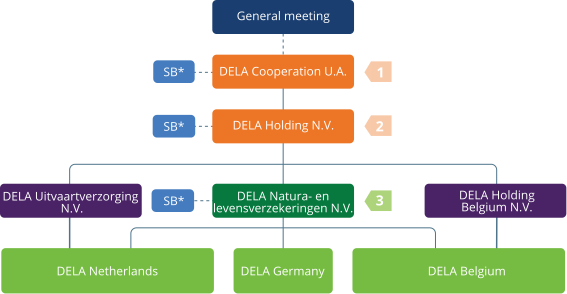
- 1: abbreviated as "DELA" (statutory) or "DELA Group" (consolidated). Board members: see personal information
- 2: abbreviated as "DELA Holding" (statutory) or "DELA Holding Group" (consolidated). Same Board members as DELA Coöperatie UA, see personal information
- 3: abbreviated as "DELA Natura" (statutory) or "DELA Natura Group" (consolidated)
- Supervisory Board: in personal union for these three entities, see personal information personal information
DELA is a cooperative with excluded liability for its members. The cooperative is formed by all insured persons who become a member of the cooperative when entering into an insurance policy with the cooperative.
DELA Coöperatie UA accommodates DELA Holding NV. The Board members of the cooperative are also the Board members of DELA Holding NV
The holding includes three principal companies: DELA Natura- en levensverzekeringen NV (hereafter: DELA Natura), DELA Uitvaartverzorging NV and DELA Holding Belgium NV.
DELA Natura accommodates the Dutch, Belgian and German insurance activities. The German activities are performed as a branch of Dutch insurance activities. This means, that like the Dutch insurance, the Belgian and German insurance fall under the Dutch licence granted by De Nederlandsche Bank.
DELA Uitvaartverzorging NV accommodates the funeral activities for the Netherlands. The Belgian funeral activities are accommodated by the principal company DELA Holding Belgium NV.
The principal companies include subsidiaries and participations.
DELA Holding NV always governs the principal companies. Each principal company governs its subsidiaries. In addition, each company may have a director. The authority of each director is defined per company in its statutes, and the authorisation regulations for the relevant company segment and in the Chamber of Commerce registrations.
The registration number of DELA cooperative at the Chamber of Commerce is 17012026.
Members
Only natural persons can become a member of the cooperative. To become a member, they must have entered into a relevant (insurance) agreement with one or more of the subsidiaries as determined by the general meeting.
The cooperative is divided into departments. The numbers, names and boundaries of the departments are described in the Rules of Procedure. Each member of the cooperative is part of a department.
DELA cooperative honorary members
| Naam |
|---|
| Mr F.H.J. Boons |
| Mr J.A.G. Dirks |
| Mr W.M. van den Goorbergh |
| Mr S.C.J.J. Kortmann |
| Mr J. Kremers |
| Mr A.J.M. Lauvenberg |
| Mr C.C.M. Libregts |
| Mr A.W.M. van de Zande |
General meeting
The general meeting of DELA Group acts as the ‘highest level shareholder’ and is formed by individuals chosen from the members of the cooperative. The general meeting consists of one member and one replacement member from each department. Both the members and the replacements attend the general meeting, which in principle takes place twice a year. Below is a list of the members at the general meeting on 16 April 2021.
The meeting discusses issues important to the DELA cooperative, such as:
- The budget for the coming year;
- The annual report of the soon to be concluded book year;
- Determining the financial statement and discharging the Executive and Supervisory Board;
- Approving changes to DELA insurance products related to all policyholders such as the annual premium increase;
- The appointment of (Supervisory) Board members.
The general meeting is also asked to consider developments important to the cooperative as well as issues such as the DELA charity funds, complaint procedures and funeral methods.
To become a member of the general meeting it is preferred that the candidate has been a member of the DELA cooperative for over five years.
The ‘Executive Board report’ in the ‘For our members’ section includes a description of the topics discussed in the general meetings in 2020.
Members of council
| Department | Member | Replacement member |
|---|---|---|
| Achterhoek | Mr W. ten Hooven | Mr E. Ruesink |
| Almelo, Enschede and surr. | Mr J. Mulstege | Mr J.J.M. Brouwer |
| Amsterdam, Amstelveen, Flevoland | Mr A. Prins | Mr B. Ramautarsing |
| Arnhem, Southeast | Ms M. van Zwam-Jagers | Mr W. Ankersmit |
| Breda | Mr A.J.M. Strik | Mr C. De Witte |
| Drenthe, Northwest Overijssel | Ms A.L. Weijenberg | Ms P.W.M. Zomer |
| Eindhoven | Mr R.P.C. Libregts* | Ms K. Wagt |
| Friesland, Groningen | Mr J.G.J.M. Wennink | vacancy |
| Region around Breda | Mr L.A.M. Everts | Mr A. Matheeuwsen |
| Region around Eindhoven | Ms A.C. van Gils-Dirks* | Mr J.W.C.M. van de Rijt |
| Region around Rotterdam | Mr J.A.M. Heppe | Ms C.C.A.E. van der Loo |
| Region around 's-Hertogenbosch, Maaskant | Mr J.E.M. Slenter* | Ms H. Litmaath |
| Region around Tilburg | Mr M.A.E. van den Boer | Ms M.A. Schaafsma |
| Helmond e.o., Kempenland | Ms J. Beerens | Ms D. de Hoon-Sanders |
| Land van Maas en Waal, Bommelerwaard | Mr R. Asschert | Mr C. Bekkers |
| Langstraat, Land van Altena | Mr N. Teunissen | Ms I. Brokken-Janssen |
| Maastricht, South Limburg | Mr R.J.P. van der Burgt | Mr I. Habets |
| Midden Meierij | Mr J.T.H.M. Schepers | Mr H.J.J. van Gogh |
| North Holland North | Mr R. de Graaf | Mr M.H. ten Have |
| North Holland West | Ms M.M. Scheen | Mr C. Hoogland |
| North Limburg and Land van Cuijk | Mr R. Oehmen | Ms L.E. De Kinkelder |
| East Central Limburg | Mr J. Zeelen | Mr J.F.P. Leurs |
| Oostelijke Mijnstreek | Mr E.E.T.M. Kalnenek | Mr J.M.W. Scholtis |
| Rijnstreek | Ms Ir. R.M.A.B. Ubachs | Mr T.W.H. de Bruijn |
| Roosendaal, Bergen op Zoom and surr. | Mr C.A. van Loon | Mr drs. R.P.A. van Meer RA |
| Rotterdam | Mr A.A. van 't Hof | Ms S.D.M. Duijsings-Mahangi |
| The Hague, Leiden and surr. | Mr J.M.M. Hoogstraaten | Ms A. Goes |
| 's-Hertogenbosch | Mr C.L. Groeneweg | Mevr. A.M.J.G. Van Lier |
| Tilburg | Ms E. Hensen-Timmermans | Ms E.H.M. Verheijen |
| Utrecht North and East | Mr G.C.A.M. van Bree* | Mr M.P. Meeder |
| Utrecht, Utrecht West, Het Gooi | Ms I. Dijst | Ms S. Pieters |
| Veluwe | Ms J.M. Spruijt | Mr R.G.J.M. Spierings |
| West Central Limburg, Westelijke Mijnstreek | Mr D.L.A.M. Bindels | Ms W.C.H.M. Bindels |
| Southeast Brabant and Brabantse Peel | Mr F.J.J. Paumen | Mr L.A. Janssen |
| Zeeland | Mr R.A.J. van de Bank | Ms I. Wojtal |
| South Holland South | Mr C.M.J. Mierop | Mr A. Scheurwater |
Confidential committee
In addition to the general member council, there is a confidential committee with four members selected from and by the general meeting.
Task
The confidential committee is tasked with promoting cooperation between the general meeting and the Executive Board and Supervisory Board within the framework of the general meeting’s authorities. In view of this task, the confidential committee is invited by the Supervisory Board to meet with them prior to each general meeting. In addition, the committee has at least one meeting a year with the Executive Board.
Term
Every member of the confidential committee is selected for a period of no more than four years. One member steps down each year in accordance with a schedule drawn up by the committee. A member who steps down can be immediately re-elected. The maximum term on the confidential committee is 12 years.
Supervisory Board
Composition
The Supervisory Board consists of at last five and at most seven natural persons as determined by this Board. If possible, there are two members who are also (replacement) members of the general meeting. The composition of the Supervisory Board is such that the combination of experience, expertise and independence of its members meets the Supervisory Board profile and allows it to perform its various duties. The Supervisory Board members are appointed by the general meeting based on the suggestion of the Supervisory Board
Tasks
The tasks and duties of the Supervisory Board include overseeing, monitoring and providing advice to the Executive Board on the realisation of the goals of the cooperative, the strategy and risks related to its activities, the setup and functioning of internal risk management and control systems, the financial reporting process, compliance with legislation and regulations, and the risk policy.
In addition, the Supervisory Board ensures compliance with and enforcement of the corporate governance structure, approving the financial statement, budget and capital investments, selecting and appointing the external accountant and auditor, approving the risk tolerance, nominating members of the Executive Board for appointment and resignation, and determining the remuneration policy. The Supervisory Board selects and nominates its members to the general meeting for appointment. It also evaluates the remuneration policy and the functioning of the Executive Board. The chair is the point of contact for alleged irregularities regarding the functioning of Executive Board members.
In fulfilling its duties, Supervisory Board members focus on the interests of the cooperative and its associated companies. In doing so, they carefully consider the interests of the various stakeholders of the cooperative, including members and employees. The Supervisory Board itself is responsible for the quality of its own functioning.
Regulations
The Supervisory Board has internal regulations that provide rules for its decision-making process. The regulations are drawn up by the Supervisory Board and then confirmed by the general meeting. They serve as a supplement to the regulations and guidelines that apply to the Supervisory Board based on Dutch legislation and the cooperative’s statutes.
Appointment and term
Each Supervisory Board member is appointed for a period of up to four years, in the understanding that a member will step down at the latest after the first general meeting held after four years have passed since their latest appointment. A member who is stepping down can be reappointed immediately, insofar as the maximum term of 12 years has not or will not be exceeded.
Committees
The Supervisory Board has an audit committee, risk committee and a remuneration and appointment committee.
Participations
The members of the Supervisory Board of the DELA cooperative are also appointed as Supervisory Board member for DELA Holding NV and DELA Natura- en levensverzekeringen NV (hereafter: 'DELA Natura Group'). The establishment of a Supervisory Board was compulsory for DELA Natura Group based on the Dutch Financial Supervision Act.
Executive Board
The cooperative has an Executive Board, which consists of a number of natural persons to be determined by the Supervisory Board. With the exception of limitations indicated in the statutes, the Executive Board manages the cooperative and its capital. The Executive Board can determine which special tasks go to which of its members. The task distribution must be approved by the Supervisory Board.
Investments
DELA Group’s investment activities are run from the Netherlands. DELA has an investment advisory committee which has an advisory and evaluating role to the Executive Board on investments. In addition, it is asked for advice regarding policy proposals, policy changes and the implementation of policy in this field. If the committee’s advice is ignored by the Executive Board, the Executive Board must report this to the Supervisory Board. The investment advisory committee meets with the Supervisory Board, Executive Board, Chief Investment Officer and director of the DELA Vastgoedmanagement BV at least once a year. It has an explicit advisory role and evaluates whether proposals are consistent, comprehensive and sound with regard to return and risk. The Executive and Supervisory Board maintain their own responsibilities. The investment advisory committee is composed of at least three external members who are appointed by the Supervisory Board as proposed by the Executive Board.
DELA Natura- en levensverzekeringen NV
One of the participations of the Group involves DELA Natura- en levensverzekeringen NV (hereafter: 'DELA Natura Group') which accommodates the insurance activities, including any related personnel. The Supervisory Board of DELA Natura Group has the same members as the Supervisory Board of the DELA cooperative (in personal union).
DELA Natura Group is supervised by The Netherlands Authority for Financial Markets (AFM) and De Nederlandsche Bank (DNB) and is registered under licence number 12000437. The Chamber of Commerce registration number of DELA Natura is 17078393.
Independent business segments
The group includes independent business segments, of which there were two at the time of writing this annual report: DELA Netherlands and DELA Belgium. DELA Vastgoed was dissolved in 2021 in view of the scaling down of the Dutch real estate portfolio.
Each independent business segment has its own management team. They report to the Executive Board, one member of which is primarily responsible for a segment. The management team has regulations that include the responsibilities and authorisations of the team. An independent business segment management team is tasked with implementing the strategy, managing and providing management information for the consolidation of the group, dealing with formal/legal issues, and sound decision-making as defined in the statutes of the segment and the regulations. This management model ensures professional and well-balanced operations with proper checks and balances.
Policy: for group or business segments
Policy that applies to the entire group falls under the responsibilities of the Executive Board and is considered group policy. Policy that relates to an independent business segment falls under the responsibilities of the management team of that segment. The management teams of the independent business segments determine their own policy within these frameworks. Group policy issues (besides secondary or tertiary policy items) include:
- Brand policy;
- IT policy;
- Remuneration policy;
- Security policy (information security and BCM);
- Privacy policy;
- Capital management policy;
- Investment policy;
- Data management policy;
- ORSA policy;
- Asset & Liability Management policy;
- Internal control policy.
Activities in Belgium
DELA Belgium comprises insurance activities accommodated by the Dutch company DELA Natura Group, and funeral activities that are part of Belgian companies (the principal company is DELA Holding Belgium NV). Insurance activities are realised within the entity DELA Enterprises NV – a branch of the Dutch entity DELA Natura Group. This means that the insurance activities are carried out under the licence issued by DNB and that prudential supervision activities are overseen by DNB. With regard to the supervision of conduct, DELA Belgium is accountable to the Belgian Financial Services and Markets Authority (hereafter: ‘FSMA’).
Activities in Germany
Marketing and sales activities in Germany take place via a branch in Düsseldorf (article 2:115 Dutch Financial Supervision Act). All other activities take place at the head office of DELA Natura Group in Eindhoven (DELA Netherlands). Conduct supervision is performed by the BaFin (Bundesanstalt für Finanzdienstleistungsaufsicht) in Germany.
Integrity
DELA finds it important to have a constant professional and well-balanced operational management with appropriate checks and balances within the right culture. The culture of DELA is characterised by the values of engagement, integrity and entrepreneurship.
Joint responsibility
The Executive Board of DELA is responsible for realising sufficient guarantees related to operational integrity. All employees are responsible for implementing operational integrity.
Code of conduct
An important part of DELA’s integrity policy is to ensure that every DELA employee acts with integrity. This means that employees are honest, open, clear and meticulous. To further define the term integrity for employees, we have published a code of conduct that indicates the rules employees should follow to enhance their integrity for various focal areas. The code of conduct and underlying regulations are based on internal and external legislation and regulations. They were drawn up for DELA Netherlands and also apply to the now dissolved DELA Vastgoed independent business segment. DELA Belgium has an integrity code with underlying regulations which are focused specifically on the Belgian situation and market, including legislation and regulations, while also being in line with the code and regulations described below.
The code of conduct includes the following focal areas:
- Details of integrity-sensitive functions;
- Conflicts of interest and corruption;
- Inappropriate behaviour;
- Reporting suspected malpractice;
- Unlawful competition;
- Private investment transactions.
Risk management
Risk management directly contributes to the long-term goals of DELA such as continuity, growth, a healthy financial position and a good service provision to policyholders at acceptable costs. It provides an insight into the sensitivities and correlations of strategic, financial, operational and compliance risks to ensure that DELA can effectively address developments, and take timely action to realise its goals and secure the continuity of the organisation.
System
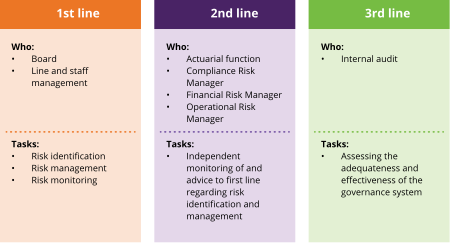
For the setup of the management and control of risks, DELA applies the ‘three lines of defence’ model:
- The first line is primarily responsible for realising the formulated goals of the company and the demonstrable realisation of internal control measures and effective risk management. Responsibilities of the first line include the operations, results, definition of risk appetite, management and compliance with internal control measures;
- The second line provides advice, coordinates, safeguards and evaluates – independently from the first line – whether or not the first line is actually taking responsibility and operating within the risk tolerance of DELA;
- The third line ensures additional security of the quality of internal control via audits.
The independence of the second and third lines is an important starting point to ensure this model functions properly, which is why it is safeguarded within DELA. The overview below shows a schematic representation of the ‘Three lines of defence’ model.
Three lines of defence model
Process
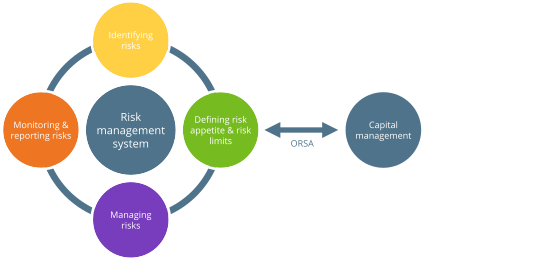
DELA has a process for risk management that ensures an insight into the risks in all circumstances and that opportunities, risks and applicable control measures are always carefully weighed. The risk management process is continuous as summarised below.
Identifying risks
Risk identification at DELA is primarily the responsibility of the first line. The second line periodically analyses the risks identified by the first line and supplements them where necessary, with a special focus on upcoming risks. This analysis is then discussed in meetings between the first, second and third line.
Determining risk appetite and risk limits
The Executive Board evaluates DELA’s risk profile every year based on predetermined operational goals and the capacity of the organisation. In addition, the Board determines the risks DELA is prepared to take – based on its risk profile – to achieve its strategic goals, in line with its risk appetite. In addition to the intended goals, it is essential that the continuity of the organisation is secured. At DELA, risk appetite consists of qualitative statements and quantitative statements translated into risk limits and risk tolerances to enable continuous monitoring and control.
Managing risks
To ensure the risks remain within the desired bandwidths, DELA applies suitable risk mitigation solutions. In most situations this involves a suitable mix of:
- Terminating or outsourcing activities;
- Reducing risks by applying preventative measures;
- Transferring risks via (re)insurance and/or the application of contract management;
- Accepting risks that can be carried by the organisation itself.
If risks are outside of the predetermined risk limits – and therefore larger than desired – management will take additional risk mitigation measures. The deliberate breach of risk limits is only allowed with approval from the Board, and only when of a temporary nature. With regard to the profit distribution, the set limit in risk appetite has been exceeded. DELA will review the Risk Appetite Statements in 2021.
The most important qualitative statements from the risk appetite are:
- DELA aims to compensate for the inflation costs of its policyholders by giving them as much profit distribution as possible;
- DELA takes market risks, taking into account the characteristics of its long-term insurance obligations and aimed at sharing profits and strengthening the core capital;
- DELA is cost-efficient;
- DELA accepts no form of internal or external fraud;
- DELA accepts no risks that could threaten DELA’s reputation.
Risk matrix
DELA applies the following risk categories:
- Strategic risks;
- Profit distribution and solvency risks;
- Underwriting risks;
- Market risks;
- Other financial risks;
- Operational risks;
- Integrity risks;
- Reputation risks;
- Other risks.
Monitoring and reporting
Monitoring and evaluating risks and the risk management system are important preconditions for the kind of a learning organisation that DELA aims to be.
In assessing a risk an evaluation is made of whether the risk stays outside the risk appetite level. The starting point is that risks exceeding the appetite are reduced to a lower risk level based on a good mix of risk mitigation solutions.
To ensure constant risk monitoring, management determines KRIs (key risk indicators) for each risk within the risk profile, monitors the development of these indicators at least once per quarter, and evaluates the extent to which risk limits and tolerances are exceeded. Extra management actions are defined when breaches occur. In addition, the second and third line periodically report to the Board.
Management periodically participates in a Risico Control Self Assessment (RCSA) process. This process results in a Control Statement (ICS) in which the internal audit service assesses the setup and effective functioning of the risk management system.
Own Risk and Solvency Assessment
Management uses the Own Risk and Solvency Assessment (ORSA) at least once a year or when developments occur that may significantly affect DELA’s risk profile. This helps determine whether the risk profile is still fitting in light of the company goals, risk appetite and available capital buffers. Various scenarios and stress scenarios are taken into account in this process.
The content of the scenarios and stress scenarios is determined by the Board before the ORSA starts, after obtaining advice from the second line.
Solvency II requires a demonstrably balanced weighing up of risk management, capital management and the corporate strategy. The ORSA is the process structure for this assessment and the degree of compliance is shown in the ORSA report.
The main conclusions from the ORSA report in 2020 for DELA are that the business model will come under pressure in a scenario of a continuing low interest rate combined with low inflation. The Board has acted on this by adapting the premium measure, which ensures that the solvency position will remain robust in these scenarios.
Capital management
DELA’s capital policy is aimed at maintaining a solid solvency position, in which DELA is constantly looking for a good balance between the amount of capital (assets) it maintains and the risks it faces. In this framework, DELA has defined a solvency benchmark: the solvency level which DELA always aims to exceed. The capital policy defines various actions should the solvency ratio drop below the benchmark. The table below shows the solvency benchmark for every licensed entity.
Solvency benchmark
% van SCR
| Entity | Solvency benchmark |
|---|---|
| DELA Group (DELA Coöperatie U.A.) | 150% |
| DELA Natura Group (DELA Natura- en levensverzekeringen n.v.) | 150% |
During 2020, the solvency ratio was constantly higher than the solvency benchmark.
Please refer to the financial statement for more details on the risks and management thereof. See ‘Consolidated balance sheet’, ‘Notes on the consolidated balance sheet and income statement’, '4. Risk'.